Table of Contents
ToggleIntroduction
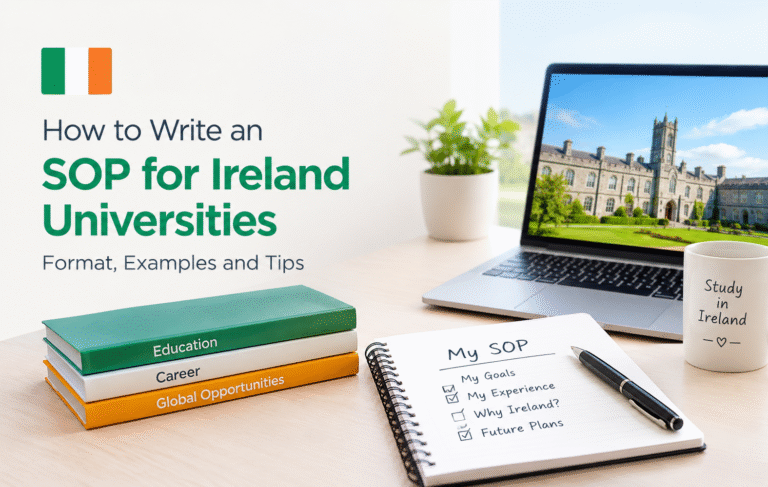
Applying to an Irish university requires more than good academic scores. Your application should clearly explain why you have chosen your course, how your previous education or work experience prepares you for it, and what you plan to achieve after graduation. A well-prepared Statement of Purpose (SOP) helps you communicate these details in a structured, personal and convincing way.
For Indian students planning to pursue a master’s degree, MBA, postgraduate diploma or bachelor’s programme in Ireland, understanding how to write an SOP for Irish universities is an important part of preparing a strong application.
However, there is no single SOP format or word limit that applies to every Irish university. For example, the National College of Ireland specifies a maximum of 600 words for its SOP and asks applicants to address particular questions, while other institutions may require a personal statement of a different length or structure.
At Jetset VAdvisor Overseas Education, we help students with profile evaluation, course and university shortlisting, SOP and Letter of Recommendation (LOR) guidance, application assistance, education loan guidance and student visa documentation. Our goal is to help you understand the application process and prepare documents that accurately represent your academic background, experience and future plans.
If you are planning to study in Ireland, this guide explains the SOP format, essential sections, writing tips, a sample SOP structure, common mistakes and ways to prepare your university application.
Find the Perfect Course Abroad in 3 Simple Steps.
Our counsellors have matched 500+ Indian students with the right course & university.
What Is a Statement of Purpose for Ireland Universities?
A Statement of Purpose (SOP) is a written document that explains your academic background, motivation for choosing a particular course, reasons for selecting a university and future career objectives.
Irish universities may use an SOP, personal statement or statement of interest to understand aspects of your application that are not fully explained by your academic transcripts or CV.
A strong SOP for Ireland universities should answer five important questions:
- Why have you chosen this course?
- Why do you want to study at this particular university in Ireland?
- How does your academic background or professional experience prepare you for the programme?
- What skills and knowledge do you expect to gain?
- How will the qualification support your future career goals?
Your SOP should connect these points into one clear explanation of your academic and professional direction. Instead of simply stating that Ireland offers quality education, explain why the course and institution suit your specific goals.
Why Is an SOP Important for Admission to Irish Universities?
An SOP gives admissions teams additional context about your motivation, preparation and suitability for a programme. It can help explain your interests, relevant projects, professional experience, course choice and plans after graduation.
A well-written Statement of Purpose can help you:
- Explain your motivation for choosing a specific course.
- Demonstrate how your previous education relates to your proposed studies.
- Highlight relevant internships, projects, certifications and work experience.
- Explain a change in academic or professional direction.
- Present realistic short-term and long-term career objectives.
- Show that you have researched the university and its programme.
Important: An SOP does not guarantee admission. Universities consider the complete application, including academic qualifications, English-language requirements, supporting documents and programme-specific eligibility criteria.
SOP Format for Ireland Universities
A useful starting point is to organise your Statement of Purpose into six sections. Treat this as a general writing framework rather than a mandatory format; always follow the instructions published for your chosen programme.
SOP section | What to include |
Introduction | Your academic or professional background and motivation for the course |
Academic background | Relevant subjects, projects, achievements and qualifications |
Work experience | Internships, employment, practical skills or relevant responsibilities |
Why this course and university? | Specific modules, learning opportunities and programme relevance |
Career goals | Realistic short-term and long-term professional objectives |
Conclusion | Your readiness for the programme and reasons you are a suitable candidate |
1. Introduction: Explain Your Motivation
Start with a clear explanation of what interests you about your chosen field and how that interest developed.
For example, a student applying for an MSc in Business Analytics might explain how an undergraduate project involving sales data introduced them to data-driven decision-making.
Avoid opening with generic statements such as “I have always dreamed of studying abroad” unless you can connect the statement to a meaningful personal or academic experience.
Your introduction should quickly establish your chosen subject, motivation and direction.
2. Academic Background and Achievements
Explain how your previous education has prepared you for the course you want to pursue in Ireland.
Include relevant details such as:
- Your undergraduate degree and specialisation.
- Subjects related to the intended programme.
- Academic projects, dissertations or research.
- Technical or professional skills.
- Relevant certifications, competitions or achievements.
Do not simply repeat your marksheet. Explain what you learned and how that knowledge connects to your proposed studies.
For example, an engineering graduate applying for a master’s in data analytics could discuss a project involving statistical analysis, programming or process optimisation if it genuinely reflects their experience.
3. Work Experience, Internships and Practical Skills
If you have work experience, explain how it influenced your decision to pursue further education.
Mention your responsibilities, relevant projects, skills developed and lessons learned. Connect those experiences to the knowledge you want to gain through your chosen programme.
Fresh graduates can discuss internships, academic projects, volunteering, independent learning or relevant extracurricular activities. Full-time work experience is not necessary for every programme, and you should not invent experience to make your SOP appear stronger.
4. Why This Course and University in Ireland?
This is one of the most important parts of your SOP.
Explain why you selected the specific programme rather than making broad statements about Ireland’s education system. Research the official course page and identify details that genuinely match your interests.
You might discuss:
- Specific modules relevant to your career goals.
- Research opportunities or practical projects.
- Industry-oriented learning, where offered.
- The programme’s academic focus.
- Relevant facilities or specialist resources.
- How the university’s teaching approach fits your learning objectives.
For instance, if you are applying for an MSc in Computing, you could explain how particular modules in cloud computing, cybersecurity or software development connect to your existing knowledge and intended career path, provided those modules are part of your selected programme.
Avoid copying descriptions from the university website. Use your research to explain your own reasons for applying.
5. Short-Term and Long-Term Career Goals
Your career goals should be specific, realistic and connected to the course.
For short-term goals, identify the type of role, industry or professional skills you intend to pursue after completing your qualification.
For long-term goals, explain how you hope to develop your expertise, take on greater responsibility or contribute to your chosen field.
For example, a business analytics applicant might aim to develop expertise in data analysis and business intelligence before progressing towards a senior analytics or strategic decision-making role.
Do not promise a particular salary, job offer or immigration outcome. Your SOP should explain your professional direction rather than make unsupported guarantees.
6. Conclusion: Reinforce Your Suitability
End by summarising why the course fits your background, interests and future plans.
A strong conclusion is concise and confident. It should reinforce your readiness to learn, relevant preparation and genuine interest in the programme without repeating the entire essay.
How Many Words Should an SOP for Ireland Be?
There is no universal SOP word limit for all Irish universities. Requirements vary by institution, course and application route.
Institution | Published guidance or example |
National College of Ireland (NCI) | Maximum 600 words, addressing four specified questions |
South East Technological University (SETU) | Up to 600 words for the postgraduate SOP guidance on its application documents page |
University of Galway | Approximately 600 words for many taught-programme personal statements, unless specified otherwise |
RCSI University of Medicine and Health Sciences | Non-EU applicants are asked for a personal statement of up to two pages |
Always verify the current instructions for your chosen programme before preparing your final document. These examples are not a substitute for course-specific requirements, and requirements may change.
If a university specifies 500 words, 600 words, a character limit or a set of questions, follow that instruction rather than using a generic SOP template.
How to Write an SOP for Ireland Universities: Step-by-Step Guide
Follow these steps to develop a clear and personalised Statement of Purpose.
Step 1: Research the course requirements
Read the official university and programme pages. Note the required documents, SOP questions, word limit and submission instructions.
Step 2: Review your academic and professional profile
List your qualifications, relevant subjects, projects, internships, work experience and career interests. Identify the experiences that best demonstrate your suitability for the course.
Step 3: Identify your reasons for choosing Ireland
Explain why the Irish study environment and your selected programme fit your academic or professional plans. Avoid relying entirely on generic statements about international exposure.
Step 4: Research your chosen university
Identify specific programme features that matter to you. Your reasons should be relevant to the institution and not interchangeable with those for every other university.
Step 5: Connect the course with your career goals
Show how the knowledge and skills offered by the programme relate to your intended career direction. Make the connection clear and credible.
Step 6: Write your first draft in your own words
Focus on clarity and authenticity before polishing individual sentences. Use genuine examples from your education or experience.
Step 7: Edit and check your SOP
Review grammar, spelling, structure, repetition, factual accuracy and consistency with your application form and CV.
Step 8: Follow the university’s submission rules
Check the final word count, file format, document naming instructions and any declaration about originality or the use of AI tools.
Sample SOP for Ireland Universities for Indian Students
The following sample demonstrates how to organise your ideas. It is an illustrative example for an applicant pursuing a master’s degree in business analytics. Replace the details with your actual academic background, experience, chosen programme and career goals.
Sample Statement of Purpose
My interest in business analytics developed during my undergraduate studies, when I began to understand how data can help organisations identify patterns, evaluate performance and make informed decisions. Through my academic coursework and project experience, I became interested in combining analytical thinking with business strategy. I now wish to pursue a postgraduate qualification that will help me develop these skills further.
During my bachelor’s degree in commerce, I developed a foundation in accounting, business management, statistics and financial analysis. My academic projects helped me understand how organisations use information to evaluate business performance. These experiences encouraged me to explore analytical tools and their applications in modern business environments.
I am applying for the MSc in Business Analytics at my chosen Irish university because the programme aligns with my interest in data-driven decision-making. After reviewing the course structure, I identified modules relevant to my learning goals, particularly those relating to data analysis, business intelligence and analytical problem-solving. I believe this programme will help me strengthen my technical knowledge while developing a broader understanding of business challenges.
I have chosen Ireland after considering the academic structure of its postgraduate programmes and the relevance of the course to my professional objectives. I am particularly interested in gaining international academic exposure and learning to approach business problems from different perspectives. My decision is based on the specific programme, its curriculum and how it fits my educational plans.
In the short term, I aim to build the knowledge and practical skills required for roles in business analytics, data analysis or business intelligence, depending on available opportunities and my developing expertise. In the longer term, I hope to progress into positions where I can use analytical insights to support business planning and strategic decisions.
I believe my academic foundation, interest in analytical problem-solving and willingness to develop new skills will help me prepare for postgraduate study. I look forward to contributing to the learning environment while building the knowledge needed for my future career.
Sample disclaimer: This is a learning example, not a submission-ready SOP. Your statement should reflect your own experiences and the specific requirements of your chosen university. Do not copy it verbatim.
How to Personalise Your SOP for Different Courses
Your Statement of Purpose should reflect the subject you intend to study. The examples below show how to adapt your focus.
Intended course | What to emphasise in your SOP |
MSc in Business Analytics | Statistics, data interpretation, business projects and analytical goals |
MSc in Computer Science | Programming, technical projects, software development and computing interests |
MBA | Leadership, work experience, business challenges and management goals |
MSc in Pharmaceutical Sciences | Relevant science subjects, laboratory work, research and pharmaceutical interests |
MSc in Engineering | Technical knowledge, engineering projects, practical problem-solving and specialisation |
MSc in Human Resource Management | People management, communication, organisational behaviour and professional development |
MSc in Finance | Financial analysis, accounting, quantitative skills and intended finance career |
The objective is to demonstrate a logical connection between your previous education, the course you have selected and your future plans.
Common SOP Mistakes to Avoid
A well-written SOP can lose its impact if it is vague, repetitive or inconsistent with the rest of the application.
- Using a generic SOP: Avoid submitting the same unchanged statement to multiple universities. Tailor it to the programme and follow each institution’s instructions.
- Repeating your CV: Explain the significance of relevant experiences instead of listing every qualification and responsibility.
- Making unsupported claims: Back up statements about your skills and achievements with genuine examples.
- Giving vague reasons for choosing Ireland: Explain your academic reasons and course-specific motivation.
- Ignoring career goals: Show how the programme connects to realistic professional objectives.
- Including irrelevant personal details: Focus on information that helps explain your motivation, suitability or readiness.
- Exceeding the word limit: Follow the exact instructions given by the institution.
- Copying online SOP samples: Plagiarism can damage your application and undermine your credibility.
- Using AI-generated text without checking the rules: Some institutions explicitly prohibit or disregard AI-generated SOPs. NCI, for example, requires the statement to be written in the applicant’s own words and warns that AI-generated or third-party statements may be disregarded. Always check the rules of your chosen university.
- Submitting inconsistent information: Your SOP should agree with your CV, academic records, work history and application details.
SOP for Ireland Student Admission vs SOP for an Irish Student Visa
These documents may serve different purposes, so it is important not to confuse them.
Aspect | University admission SOP | Student visa statement or supporting explanation |
Main purpose | Explain academic motivation and suitability for a course | Address the requirements relevant to the immigration application |
Typical content | Academic background, course choice, university fit and career goals | Study plans and supporting explanations relevant to the applicable visa requirements |
Requirements | Set by the university and programme | Set by the relevant immigration authority and application route |
Format | May be an SOP, personal statement or set of written responses | Depends on the current visa application instructions |
A university SOP is not automatically a substitute for any statement or evidence required for an Irish student visa. Check the current official immigration guidance and ensure all documents are accurate and consistent.
How Jetset VAdvisor Helps with SOP and Ireland University Applications
Writing an SOP is one part of preparing your study-abroad application. Students also need to identify suitable courses, check entry requirements, organise documents and plan their finances.
Jetset VAdvisor Overseas Education supports Indian students with guidance throughout this process, including:
- Profile Evaluation and Career Counselling
We help you review your academic background, interests, experience and future plans to identify suitable study options.
- Course Finder and University Shortlisting
We guide you in comparing relevant programmes and universities based on your profile, eligibility, budget and academic goals.
- SOP, LOR and Document Guidance
We help you understand SOP requirements, organise your academic and professional information, and improve the clarity and relevance of your application documents in line with university instructions. Your personal statement should remain authentic and comply with the institution’s rules.
- University Application Assistance
We guide you through application requirements, document preparation, submission procedures and follow-up.
- Education Loan and Financial Planning Guidance
We assist with secured and unsecured education loan options, eligibility considerations and documentation to help you plan your study-abroad budget.
- Student Visa and Pre-Departure Guidance
We support students with visa-document preparation, application guidance and practical pre-departure planning.
We also provide guidance on international tuition fee payments, including Flywire where applicable, and help students understand English-language test preparation options.
Our aim is to help you make informed decisions at every stage, from selecting a suitable course to preparing a complete application.
Plan Your Ireland University Application with Jetset VAdvisor
A strong SOP starts with a clear understanding of your academic profile, course requirements and future goals. If you are planning to pursue a master’s degree or another qualification in Ireland, preparing your application early can give you more time to research programmes and organise your documents.
At Jetset VAdvisor Overseas Education, we guide students from Mumbai, Thane and nearby areas through course selection, university applications, SOP and LOR guidance, education loan assistance and student visa documentation.
FAQs
How do I write an SOP for Ireland universities?
Start by researching your chosen programme and its requirements. Explain your academic background, reasons for selecting the course and university, relevant experience and future career goals. Keep the statement specific, authentic and within the prescribed word limit.
What is the ideal SOP format for Ireland?
A useful general format includes an introduction, academic background, relevant experience, reasons for choosing the course and university, career goals and a conclusion. However, some institutions provide specific questions or different formats, so follow the official instructions.
How many words should an SOP for Ireland contain?
There is no universal word limit. Some postgraduate programmes request approximately 600 words, while other courses may specify a different limit or a page-based personal statement. Check the current requirements for your chosen programme before writing.
Can I use the same SOP for multiple Irish universities?
You can use your academic background and career goals as a foundation, but you should personalise the statement for each programme. Explain why the specific course and university suit your goals, and follow any rules regarding originality or AI assistance.
What should I include in an SOP for a master's in Ireland?
Include your relevant undergraduate education, academic projects, work experience where applicable, reasons for choosing the programme, knowledge of the university and realistic career objectives. Emphasise experiences that demonstrate your readiness for postgraduate study.